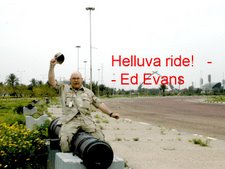
Wednesday, April 13, 2011

Small Victories and the Run to Hue

by Ed Evans, MGySgt., USMC (Ret.)

April 11, 2011

It was the first warm Monday of a late spring in Nashville, and I was scheduled for an early morning stress test at the VA Hospital. My new doctor, a very conscientious young man, was attempting to determine the cause of my shortness of breath and sometimes loss of equilibrium. I tried to tell him the cause was 'cause I'm 70 years old.

The VA Hospital here in Nashville, Tennessee, is much improved -- from services to attitudes -- from what it was 20 years ago when I first began going there for treatment of my Graves Disease related lack of adrenaline and the after affects of a Vietnam-era gunshot wound to my lower left leg. And it should be one of the best in the nation, since an agreement with Vanderbilt Hospital makes it part of Vandy's teaching experience for new doctors. But to be truthful, at my elder age I'm skeptical of all doctors. My experiences lead me to remind everyone that doctor's are only guessing when they diagnose, and that's why they call it a medical "practice."

When I was in VA Hospital a few weeks ago, I had four doctors attempting to determine why I came into the hospital emergency ward on a Friday night in extreme pain and sickness. My symptoms were a feeling that something was eating my gut, with a steel band of pain across my upper chest. When I had left the house so my wife could drive me to the hospital, I had dry heaved in the bushes, a reaction to the pain in my gut.

When I got to the emergency ward, they determined my blood pressure and temperature was up, they needed to keep me in the hospital, but no diagnosis as to why the pain. It stayed that way all Friday night until Saturday afternoon when I passed the gall stone that I had said I thought was the source of my pain. Meanwhile they had taken x-rays, CAT scans, poked, prodded, taken blood, given me intravenous solutions and even insulin shots in the stomach since my aggravated pancreas had stopped making insulin. I don't know that they ever actually agreed on a diagnosis, after all, where was the evidence? But I'm satisfied that what they could not determine, the Divine Healer handled. For, being a retired preacher as well as a retired Marine, I was surrounded in prayer by a great company of prayer warriors.

Thirty years ago, when my Graves Disease first attacked my thyroid, dropping me in weight from my customary 160-lbs to 95-lbs, and robbing me of any ability to think ahead, the medical community told me I was depressed about my pending military retirement. It was only when I insisted they at least do a simple blood test that I was diagnosed with Graves Disease.

So you can see why I approach the medical craft as a necessity in our lives, but I tend to take their assurances and sureties with a smile and a wink. I feel certain they are well-trained and serious about their craft, but I probably know my body better than they do, and I know the Great Healer.

Now, I will admit to being a bit sensitive about my age. I hate when the young girls at the grocery store insist they should help me carry my groceries to the car. And I guess I should be pleased when clerks want to give me a senior discount. After all, this old face does show its age, a fact I'm not unhappy about. It's been a rough ride, and some of those roads weren't paved.

But getting back to my Stress Test this past Monday, once again my age led them to treat me with concern. And that was understandable. I have no complaints there. But I had my own agenda.

The doctor was a young lady of about 25, the friendly technician was about the same age. They probably each asked me at least five times, "Do you have any questions?" They were so thorough in their explanations about what was to happen there was no need of further questions.

They had given me some sort of intravenous radioactive material, then performed a 15-minute CAT scan of my upper torso, then I was to perform the treadmill exercise, then they would follow up immediately with another CAT scan. Actually, I had a choice of the treadmill physical event, or they would give me an intravenous medication that would artificially stress my heart. Perhaps you can understand why I chose the treadmill. I wasn't sure they could. They kept asking me if I was sure that's what I wanted to do. I assured them it was.

The technician fitted my left arm with an intravenous device into which he could fit a syringe that would be used during the treadmill test. He explained that when I reached the right heart rate, and when I was about at the end of my ability to keep on, they would pump a certain liquid into me that would help them determine the condition of my heart.

They told me my resting heart rate was around 80, and they would need to get it up to 128 beats per minute for a good test. Could I do that? At least three times I assured them I felt I could. As they rigged me with heart monitors and other wires and connections, the technician talked about the good weather we were having and how he looked forward to getting into the great outdoors. He had not heard about Tennessee's best kept secret, Big South Fork, a National Park in middle Tennessee near Jamestown, and I shared with him the joys of having such a wonderful wild area so near Nashville, full of natural arches, hiking and riding paths, and the abundance of wild deer, birds and other animals along the trails by spring-fed waterways. It was once a private hunting preserve, but now the beautiful ridges and waterfalls are open to everyone, and much closer and less crowded than the Great Smoky Mountains.

Finally they were ready. The treadmill had a bar across the front with which to steady yourself, and bars on either side to keep one from falling off. The technician told me how some people had never used a treadmill and what some of the dangers were. I assured him I was familiar with the equipment.

They started out with a gentle walk, the doctor and the technician watching a bank of blinking monitors, glancing at me now and then. She pushed a button and the speed increased. I walked faster and fell into a rhythmic breathing pattern. My heart rate increased dramatically as the speed increased again, reaching 128 and continuing to climb. Now they glanced at me more often. I was enjoying the exercise.

"When you feel you can only go for one more minute," the doctor advised, "let us know so we can put this liquid into your blood stream."

"Okay," I said as I huffed and puffed. I was almost running now.

A few more minutes and my heart rate was at 154. Now it was the technician telling me to let them know when I was about out of steam.

I told them to go ahead and choose when they wanted to put the syringe in, because I could keep going.

The technician looked at the doctor, she looked at him, he said, "Well, okay, you've impressed us!"

At that he leaned over me, attached the syringe and emptied the liquid into my vein. After a few more minutes of them watching the monitors, they began to slow the treadmill until it finally stopped and I stepped off. Since they had not slowed it to a walk for a few minutes, but stopped it rather quickly, I was still breathing heavily. They asked if I was okay.

I replied, "I don't recover as fast as I used to, but I'll be fine in a few moments," and even as I spoke my breathing began to return to normal.

That exercise was then followed by another CAT scan of my upper torso, then I was finished. They told me I would hear from my doctor at some later date concerning the results. As I walked down the halls of the VA toward the garage where I had parked my green van, covered with Marine Corps stickers, I almost felt like I was walking a little taller, even with my customary left leg limp. The words were echoing in my ears, "Well, okay, you've impressed us!"

Small victory, but a great moment when you're 70 years old. Now, if I can only still do that when I'm 80!

Postscript.....How It's Done

I'll share a secret that I learned in the Marine Corps for going beyond "what you can do." First, this "secret" is fifty years old, and it's not all that secret. It is simply "continuing to march" when you think you can't. How? You change your thinking.

It's a fact of life that when faith leads, courage will follow. And sometimes, even in something as simple as pushing your body beyond what you think you can do, it takes an element of courage. But if faith leads, courage will follow.

It's something I have practiced all my life. There was a time when three of my four sons were teenagers, while I was still in the Marine Corps, and they would go running with me. Obviously, being younger, they challenged me. My number two son, Michael, used to taunt me on the run by running backwards in front of me. "C'mon, old man, is that the best you can do?"

Michael seemed to be a natural athlete, and he could always outrun me. He told me one day he had learned the secret to running. "You just run until it hurts, Dad," Michael explained, "then you keep going." True. Different people have different ways for making that happen. Some concentrate on their breathing, some repeat a mantra in their mind, some pick out a target in the distance and run to it, then select another target ahead.

For me, it was always the story of Gunnery Sergeant Hartman. When I was stationed at Marine Corps Air Station, Cherry Point, N.C., about the time my boys would run with me, we had a base commander who was a spirited runner. He liked to go on runs, would do that every noon hour, and he wanted his Marines to be as enthusiastic about running and staying in shape as he was. So he arranged to have a formal three-mile cinder track built on the base. I was about 35 at the time, and my left leg gunshot wound from Vietnam was only about five years old. Running was difficult for me at that point in my life, but I had been promoted to the highest enlisted rank, Master Gunnery Sergeant, and led of team of about 20 enlisted Marines. Marines always lead from the front, so I had to make running work for me.

When I would go running, I would often see GySgt. Hartman out there. He always looked like he was in deep physical distress, but he kept on running. Always. He never fell out, never slowed, never walked. He ran.

One day I had the opportunity to sit and talk with him, and I asked him point blank, "You look like you're about to fall over out there. How do you keep going?"

That's when he told me about Hue, South Vietnam. I was in Vietnam when the enemy attacked the beautiful city of Hue during the 1968 Tet Offensive, and I knew the Marines sent a relief column of tanks and infantry to help the outnumbered Vietnamese soldiers.

Hartman told me he was in one of those relief columns to Hue, about an hour's drive north from the 3rd Marine Division headquarters at Phu Bai Combat Base.

"We knew the best warriors in the city, the Hoc Bao (Black Panthers) had left the city and come south to assist our Marines along Highway One, our small teams of Marines within the villages who were being overrun by the North Vietnamese Army. So while they had a few South Vietnamese Army troops there, still the Hoc Bao's families and all of the Catholics there would be at the mercy of a merciless enemy. Other Marines were there ahead of us, and they needed our support. We had to get there.

"But our unit," he continued," had to go by shanks mare (by foot). All the mechanized traffic was busy elsewhere. We started out marching, then, as the Battalion Commander began to get updates on Hue, we realized the situation was desperate. At some point the command was given, "Double time, march!", and we began to run, still in ranks, our weapons before us at port arms, we ran toward Hue.

As Hartman paused, I thought I saw a misty look in his eyes.

"It was too far to run," he said. "But we ran. Women and children, the families of the Hoc Bao were being slaughtered. They were finding mass graves of priests and villagers. We had to get there. So we ran."

"Now," he said, "when I'm out here running, and there's just nothing left, I start running for Hue. I run to Hue. And I don't stop."

It's been about 21 years since I've seen Gunny Hartman, but I can remember every word. And like him, when the body wants to quit, when you just run out of gas, I run to Hue, the adrenalin flows, I run to Hue, and I don't stop.

That's the Marine Corps way ... improvise, adapt and overcome. Semper Fidelis.

Monday, March 28, 2011

Wanna Know What's Going on in Libya? Ask Al Qaeda. They Know. We Don't.

By the Master Gunny

Dr. Peter Waldron, head of Advancing American Freedom, asks the question, "Who are the rebels in Libya? Obama did not identify who the rebels are.

"According to a report in the British media, a key rebel leader is Abdel-Hakim al-Hasidi. Hasidi left Libya to fight against "the foreign invasion" of Afghanistan in 2002. In other words, he left his homeland and joined Al Qaeda to wage jihad against U.S. forces.

"The president of Chad, on Libya's southern border, is warning that Al Qaeda forces in Libya have pillaged Libyan military arsenals and seized major weapons, including surface-to-air missiles. Al Qaeda is promising to impose its version of Islam on the country once Qadhafi is gone. If that happens it helps the Islamists achieve their goal of a Middle East caliphate."

It's pretty clear the U.S. is not in control of what is happening in Libya, and entered into that fray with nothing more than military goals in mind. When it is over, we will not be in control, but it seems pretty clear Al Qaeda will be. And that helps the American position in the Middle East how?

We entered into this following after the French, without consulting the U.S. Congress, without working through the multiple possible consequences, and now we are asking NATO to take the responsibility for this fight off our hands. That we could do what we did militarily was never in question. In fact, we could have done a great more. But there is a lingering question of what our goal is and who is in charge.

For example, on a Sunday morning CBS News show, the U.S. Secretary of Defense, Robert Gates, said explicitly there were no U.S. ground troops in Libya. He said that even though the news media days before had announced the explicit presence of U.S. Army Special Forces personnel inside Libya. He explicitly lied. Or he just didn't know what was going on. Either possibility should be disturbing enough to launch at least a Congressional inquiry into what we know, when we knew it, and who the heck knows!

In terms of leadership, morals, and ethics, it seems to be every man for himself. How long before America's enemies quit trying to figure out who is in charge, and decide to begin taking us in charge?

Saturday, February 19, 2011

The Hard Sayings of Jesus, by Pastor Ed Evans

Scripture: Matthew 5:38-48

5:38 "You have heard that it was said, 'An eye for an eye and a tooth for a tooth.'
5:39 But I say to you, Do not resist an evildoer. But if anyone strikes you on the right cheek, turn the other also;
5:40 and if anyone wants to sue you and take your coat, give your cloak as well;
5:41 and if anyone forces you to go one mile, go also the second mile.
5:42 Give to everyone who begs from you, and do not refuse anyone who wants to borrow from you.
5:43 "You have heard that it was said, 'You shall love your neighbor and hate your enemy.'
5:44 But I say to you, Love your enemies and pray for those who persecute you,
5:45 so that you may be children of your Father in heaven; for he makes his sun rise on the evil and on the good, and sends rain on the righteous and on the unrighteous.
5:46 For if you love those who love you, what reward do you have? Do not even the tax collectors do the same?
5:47 And if you greet only your brothers and sisters, what more are you doing than others? Do not even the Gentiles do the same?
5:48 Be perfect, therefore, as your heavenly Father is perfect.

Sometimes commitment hurts. But if life were easy, why bother? Why would we be here if there were no challenges to overcome? If commitments didn't cost us something. If love didn't have a price?
Fair warning. I'm going to "step out from behind the pulpit", where it's safe to talk about Christ, and I'm going to talk about Christ and life, Christ and you and me and the future, Christ and politics.
The first two never cause a ripple. That last one -- Christ and politics -- sets some people's hair on fire. In fact, we're told from childhood that if we want to keep our friends, never talk religion and politics. So I'm crossing both barriers in this sermon.
Fortunately for me and my status, I have no 501C3 or charitable rating to endanger with the IRS. So I can speak freely. And I intend to.
We are moving into the fertile arena of another presidential election. Already the electioneering is beginning. For some, honestly, it never stopped. But the principle people, such as President Barack Obama, are stepping up their campaigning even at this early date.
Note how those who are serious about this coming election are seeming to move to the center, where most of the voters will be. There are extremists on the right and on the left who will not be swayed regardless of what candidates say. But those in the center, they may still move left or right, or be convinced that this candidate or that candidate is a centrist, after all.
Which is to say, a supreme selling job is about to be enacted on all of us. How will we react?
How did Christ react when people needed healing?
He healed them. We cannot do that, but we can hold them up to Christ in prayer to be healed. We can do that.
How did Christ react to people in need?
He provided for them; loaves and fishes for the hungry; wine for the wedding.
We might be able to do that, depending on our resources. Otherwise, we hold their needs up to Christ in prayer. We can do that.
How did Christ react to people who dishonored Almighty God?
He took a whip and he drove them from the House of God, the Temple.
Be careful now. Don't jump to any conclusions too quickly.
First of all, our churches are no long houses of God, but where we worship God. Paul pointed out that our bodies are now the temple of God. So if we would drive out that which dishonors God, we might want to begin with ourselves.
But yes, there is a great deal more that dishonors God than just ourselves and what we do, or what we neglect to do. And I'm not recommending we take a cat-o-nine tails to them, although I must confess that when I see and read what some unprincipled politicians do that so adversely affects the integrity and the morality of this nation, the thought crosses my mind.
Supporting and providing resources to murder millions of innocent babies is one of things they do that I cannot stand. The siphoning of off resources to support such blatant evil, and the manner in which those innocent children die, I admit my eyes are awash with tears every time I read of it, every time I think of it.
I wish we would forget the word "abortion" call it what it is, child-killing, baby killing, infanticide. The deaths of so many tiny gifts of God, whose angels are continually before God, each moment, each day, forever, this is a bleeding sore on the face of America, home of the free, because of the brave.
Among our elected representatives, there are those feathering their own nest as they provide luxuries only for those who elected them, while piling debt upon debt on the shoulders of those yet unborn.
Many of our elected, who have sworn to uphold the Constitution of the United States of America, need to read the wording of what they have sworn, before Almighty God, to uphold.
But if they choose not to, as they have repeatedly in the past, if they choose to follow their own personal and political agendas, what can the followers of Jesus Christ do about it? Shall we hold with this political party, or that political party, or start our own political party? Bearing the name and practices of Jesus Christ, what can we do?
When Jesus walked this earth, He was born into a very hard and cruel society. The Jews were under the political thumb of the Romans, a very harsh lifestyle to be endured.
Whose cause did He support? Was it that of the Romans? The Pharisees? The Sadducees?
He supported God's cause. Was that the wise thing to do? After all, He was crucified for His stand, by the Romans, and under the approval of the Pharisees and Sadducees.
Take notice, the Romans are long gone. The Pharisees and the Sadducees have disappeared from this earth.
God is still here. The Christ lives. We have the Holy Spirit as He promised.
What can we, who worship God in spirit and in truth, do except walk in the footsteps of our Lord and Savior?
How could we not uphold the truths and the principles of Almighty God? How could we not insist on integrity, ethics and morals from those we elect to represent us? How could we ever explain to God Almighty why we have put into power those who actively work against the cause of Christ?
But be careful, there are many causes, associations, groups forming even now who are quick to take a stand against the evil that is happening in America, but do it for reasons and with methods that are outside of Christ. This nation was begun on Godly principles, and it cannot be returned to "one nation under God" without adhering to those same Godly principles.
The schools, the hospitals, the colleges, the charitable organizations of early America, all begun by Christians. But over time we have lost Christ's influence in our society, with many wrongs done in His name, and many wrongs perpetrated by those who worship idols and false gods. Christianity is not merely something we do on Sundays to put on a good front, Christianity is lived every moment of every day, or what we are practicing is a false religion.
That great Christian Gilbert K. Chesterton once said, "Christianity has not been tried and found wanting; it has been found difficult, and not tried." How do we dare assert that ours is a Christian nation, and not demand that our elected representatives conduct themselves Christ-like on our behalf?
G.K. Chesterton's wisdom also extended to the observation that "God probably told us to love our neighbors and our enemies because they are the same people."
I bring up his quote here because I want to point out the gap between how we often conduct ourselves in political matters, and today's scripture. Somehow when we begin discussing politics and politicians, the anger and self-righteousness come to the fore, and we forget what Christ told us in Matthew 5:38-48.
What about not resisting evil doers, turning the other cheek, giving them your cloak when they take your coat, and going the extra mile? Can we love those who persecute us and despitefully use us?
What is Christ telling us here? Conduct ourselves as Christians, in His name. Did Christ strike out at those who beat him, spit upon Him, bloodied and misused Him?
No, He did not. We are to conduct ourselves as Christians, not as those who make fun of those we believe to be the enemies of Christ, not name-calling, not humorous but cruel caricatures, not trading insult for insult, not striking back. "Vengeance is mine," says Almighty God in Romans 12:19, and He will repay.
We are to act Christlike, for we bear His name, and we walk in His steps.
But walking in His steps, do we support evil? No. Do we work for that which is good and kind and Christlike? Yes.
Can we equivocate and support those who are 90 percent well-meaning, but 10 percent for condoning evil? No.
Can we support those who believe you must work with evil to find a middle ground? No.
You are either 100 percent for the things of God, for that which is Christlike, or you stand with the enemies of God. There is no middle ground. There is no room for "a little bit of evil" on holy ground. That's a choice you and I must make.
Joshua spoke for many of us when he said very clearly in Joshua 24:15: "But if serving the Lord seems undesirable to you, then choose for yourselves this day whom you will serve, whether the gods your ancestors served beyond the Euphrates, or the gods of the Amorites, in whose land you are living. But as for me and my household, we will serve the Lord.”
The Israelites had become infested with the idol gods of many other nations, just as America today is filled with the religions of many different lands and peoples, and we have whored after them for this favor and that, this benefit and that, and lost sight of the Living God in favor of idol worship; sports figures, money, fame, fortune, beauty, and things.
In the previous verse, Joshua urged the people to " Throw away the gods of your ancestors..." Get rid of the humanistic worship of self that grows among us and get back to God. He has neither moved nor changed who He is.
If we would say with Joshua today, "...We will serve the Lord...", then we need to get back to worshipping God and supporting only those who represent us in our government who also represent the integrity, the ethics, and the morals of God Almighty. Really, that isn't as hard as it might seem, when we stand in the love of God and refuse to accept any substitutes. If you love Him, stand for God. Amen.

Saturday, January 29, 2011

Together Under the Cross, by Pastor Ed Evans

Scripture: 1st Corinthians 1:18-31
1:18 For the message about the cross is foolishness to those who are perishing, but to us who are being saved it is the power of God.
1:19 For it is written, "I will destroy the wisdom of the wise, and the discernment of the discerning I will thwart."
1:20 Where is the one who is wise? Where is the scribe? Where is the debater of this age? Has not God made foolish the wisdom of the world?
1:21 For since, in the wisdom of God, the world did not know God through wisdom, God decided, through the foolishness of our proclamation, to save those who believe.
1:22 For Jews demand signs and Greeks desire wisdom,
1:23 but we proclaim Christ crucified, a stumbling block to Jews and foolishness to Gentiles,
1:24 but to those who are the called, both Jews and Greeks, Christ the power of God and the wisdom of God.
1:25 For God's foolishness is wiser than human wisdom, and God's weakness is stronger than human strength.
1:26 Consider your own call, brothers and sisters: not many of you were wise by human standards, not many were powerful, not many were of noble birth.
1:27 But God chose what is foolish in the world to shame the wise; God chose what is weak in the world to shame the strong;
1:28 God chose what is low and despised in the world, things that are not, to reduce to nothing things that are,
1:29 so that no one might boast in the presence of God.
1:30 He is the source of your life in Christ Jesus, who became for us wisdom from God, and righteousness and sanctification and redemption,
1:31 in order that, as it is written, "Let the one who boasts, boast in the Lord."

In 1995 I lost a one of my best friends to a fast-growing brain tumor, called a blastoma. Within three months of being diagnosed, he was gone. He and I had met on the battlefield in Vietnam in 1970 and survived many close calls. He was one of the most dynamic, creative, can-do people I ever met. A very giving person, his enthusiasm for life actually drew people to him.
However, for all of his positive, upbeat outlook on life, he had a great sadness he carried around with him. His father was a preacher, pastor of a church that believed it was the only church true to Christ. His father refused to perform or even attend my friend's wedding to a lovely and loving Christian girl. My friend professed to being a Christian, but his knowledge of Christ was forever stunted, and he refused to attend any church believing, even as he said he loved Christ, that churches were hypocritical. His experience with his father's church had forever warped his Christian experience. Unity of the body of Christ was not a concept understood by his father's church, nor by my dear brother in arms.
Unity is exactly what Paul is writing about here in the very first chapter of his first letter to the Corinthian church. Paul states the case plainly, there are only two groups here, the perishing and the saved. No in-betweens, no some of this group and some of that, no something less or something more. You are either among the perishing, or among the saved. And he drives the point home with the word "foolishness", parading it before us five times in eight verses. It helps to know that the word Paul is using as he writes in the Greek is the word "moria". In 1:15 is appears as the adjective "moros".
Our word "moron" comes from this word. In today's lexicon it would be properly understood that Paul was saying that to some the cross of Christ is "moronic." To some the cross is also what we translate that word to be, foolishness.
There are many in the world who look at Christian churches today and there behind the altar, there atop the church or chapel or cathedral, there hanging around the neck of the Christian man or woman is an instrument of torture, a sign of embarrassing punishment. Why do Christians do that? The very Christ they worship was crucified -- a death of indignity and shame -- on a cross like that.
The great British evangelist and world traveler Ian Thomas once preached a sermon about how difficult it was for him to "like" the cross. He spoke of the old hymn "The Old Rugged Cross", by George Bennard. That hymn begins, "On a hill far away stood an old rugged cross, the emblem of suffering and shame; and I love that old cross where the dearest and best for a world of lost sinners was slain."
Thomas equated it to his mother being slain with a knife, and him singing, "I love that old knife that murdered the mother I love."
He understood the necessity of the cross, and even of the death of God's Son, our Savior, bringing us back to God through the sin-covering righteousness of Jesus Christ crucified in our place. But he stumbled over loving that instrument of torture that brought such pain to our sweet Jesus.
And much of the world agrees with Ian Thomas, though for different reasons. To make an icon of a crucifixion cross is akin to lionizing an electric chair, or a hangman's noose, says the world. They do not understand it. It is foolishness. It is moronic.
Writing out of his own time, Paul pens an explanation that is as meaningful today as it was 2000 years ago: "For Jews demand signs and Greeks desire wisdom,
we proclaim Christ crucified, a stumbling block to Jews and foolishness to Gentiles,
but to those who are the called, both Jews and Greeks, Christ the power of God and the wisdom of God."
And then right there, Paul gives us a glimpse of the mind of God. Who may know the mind of God? And yet, as God has shared with Paul, he shares with us. Paul explains in verse 25, "For God's foolishness is wiser than human wisdom, and God's weakness is stronger than human strength," and in verses 27 and 28, " But God chose what is foolish in the world to shame the wise; God chose what is weak in the world to shame the strong; God chose what is low and despised in the world, things that are not, to reduce to nothing things that are, so that no one might boast in the presence of God."
It is not of us, not through our energy, our intellect or creativity, not of our wisdom, but of Him. He must increase and we must decrease.
Look back quickly at verse 1:18. Once again we have the two groups, the perishing and the saved, "but to us who are being saved it is the power of God.”
What did that say? It -- the cross of Christ -- is the power of God! This is the power that assures us that salvation is freely granted by God's grace, not through anything we have said or done, not by anything we have decided or accomplished, but by the power of God, through the cross of Christ.
And it is right here that the cross becomes an offense to men of pride. Because every one of us, beggar and millionaire, bookworm and stellar athlete, we all come to God through faith, based upon the work of Jesus Christ on the cross. The ground is level for each one of us at the foot of the cross. Neither money nor wisdom nor accomplishment nor anything we can do will get us to the foot of the cross; only faith.
How foolish is that? It is said that what men and women do not earn for themselves they lightly esteem. And that is true, in this world, but the spiritual world operates by God's laws, not ours.
When I was working in Tokyo, Japan, I had the opportunity to climb Mount Fuji, an extinct volcano so huge it is visible throughout most of Japan. One of my young sons and I climbed this venerated symbol of Oriental strength with a group of young Christians beginning in the morning, and reaching the top sometime that night. We slept in a small lodge just below the summit, awakening in the morning to an amazing sight. The morning sun was bright and all around us lay a white, fluffy layer of clouds as far as the eye could see. We awoke above the clouds atop Mount Fuji! As we had breakfast and prepared to climb down, the clouds dissipated and the sight was even more awesome as the land far below us appeared as a rumpled quilt of many squares and varying colors depending upon the crops and fields of tea.
We felt very small and almost insignificant by comparison so high on Mount Fuji. It was as though we could almost touch that cobalt blue sky. The same kind of humbling dynamic takes place in our hearts when we draw near to the awesomeness of God's glory, recognizing and understanding, adoring the cross of Christ that gave us such unparalleled victory. It is beneath this cross that our differences disappear and we achieve unity in a divided church, as the body of Christ comes together in worship of God, allowed there by the Christ on the cross, the basis of our unity.
For there He hung, between heaven and earth, opening the gateway to God for you and for me. Do the words of George Bennard's old hymn not come back you.....?

On a hill far away stood an old rugged cross,
the emblem of suffering and shame;
and I love that old cross where the dearest and best
for a world of lost sinners was slain.
Refrain:
So I'll cherish the old rugged cross,
till my trophies at last I lay down;
I will cling to the old rugged cross,
and exchange it someday for a crown.

O that old rugged cross, so despised by the world,
has a wondrous attraction for me;
for the dear Lamb of God left His glory above
to bear it to dark Calvary.
(Refrain)

In that old rugged cross, stained with blood so divine,
a wondrous beauty I see,
for 'twas on that old cross Jesus suffered and died,
to pardon and sanctify me.
(Refrain)

To that old rugged cross I will ever be true,
its shame and reproach gladly bear;
then He'll call me some day to my home far away,
where His glory forever I'll share.
(Refrain)

Amen.

Tuesday, December 28, 2010

Fighting back against sodomized military

COMMENT: Political promotion of a human perversion does not make it any the less offensive, and those who thought surely common sense would prevail are now making their voices heard. "No" needs to be said loud and clear!

Fighting back against sodomized military (OneNewsNow.com)
http://www.onenewsnow.com/Politics/Default.aspx?id=1260920
A national defense analyst and Pentagon advisor says the new Congress can take a number of actions to blunt the impact of the new law that allows homosexuals to openly display their lifestyle in the U.S. military.

Friday, December 24, 2010

Redefining the Season of Giving

In a time of lost jobs, lost wages, and difficult times, some Americans are still redefining the season of giving.

Unemployed Father Takes In Homeless Family For Christmas
http://www.huffingtonpost.com/2010/12/22/unemployed-father-takes-i_n_800457.html
Gregory Schauer, an unemployed man who, despite not having enough money to buy Christmas presents for his own kids, was able to give an amazing gift to people he didn't even know when he opened his home and took in a homeless woman and her three children for the holidays. "I can just barely cover all my bills," he explained, "but I know there are people who are worse off than I am right now." His generous and uplifting gesture reminds us that Christmas giving need not just be about putting the hippest new gadget or must-have toy under the tree - but about demonstrating the caring and selflessness that are the true heart of the Christmas spirit.
See also the Devotional on this at http://www.guildofchrist.com/

Thursday, December 23, 2010

WashPost: Marine Corps Commandant Has to Go

The following is a Commentary from Washington Post writer Richard Cohen, followed by my response to him.
Marine Corps commandant has to go
By Richard Cohen
http://projects.washingtonpost.com/staff/articles/richard+cohen/
Monday, December 20, 2010; 8:00 PM
I am a fan of the old World War II movies, the ones where the platoon was composed of typical Americans, Hollywood-style. There was a guy named Farmer and one called Preacher and another called Brooklyn (who was killed shortly after receiving a salami from home), no blacks and, of course, an officer who was good-looking and clearly a white Anglo-Saxon Protestant of the John Wayne variety. Now, of course, we would have to add a gay soldier. I fear for him. He'll need someone to watch his back.
THIS STORY
>The repeal of the odious "don't ask, don't tell" law has been 17 years in the making. It could have been done much sooner had it not been for the political cowardice and/or ignorance of much of Congress and some of the military. The nation as a whole was way out in front of these institutions, having learned from their own kids and society in general that gays and lesbians were not drooling perverts but human beings with a different - not better and not worse - sexuality. Most of us know this now.
There's good reason to believe, however, that this lesson has not been universally learned. In the run-up to the vote in the Senate, Gen. James Amos, the Marine Corps commandant, showed how he felt about the prospect of open homosexuals serving in the Marines. He was particularly concerned about combat situations where, he thought, gays might be "a distraction." "Mistakes and inattention or distractions cost Marines' lives," Amos said. This was not the first time the general had expressed his doubts. Earlier, he had talked about what might happen when his Marines were "laying out, sleeping alongside of one another and sharing death, fear and loss of brothers. I don't know what the effect of that will be on cohesion. I mean, that's what we're looking at. It's unit cohesion. It's combat effectiveness."
It's easy to dismiss Amos, but his concerns fall within the realm of possibility. After all, being gay is a sexual matter and young people are nothing if not sexual. This is the way it is supposed to be. This is also the problem with having women in the armed services or, if you are a radical feminist, having men. Sooner or later, a certain amount of unacceptable harassment will occur, abuses will be committed and, more innocently, plain hooking up is going to happen. We know this.
But we know also that this can be managed - contained, limited. It takes education. It takes training. It takes leadership. This is what concerns me about Amos. His views are on the record. He sees gays as somewhat out of control, possibly holding hands in combat, sneaking into one another's bunks at night, being distracted just as the enemy is coming over the hill. Not only is this silly and based on an ignorant misconception of who most gays are, but it can be dealt with.
Amos, though, is the wrong man to deal with it. His subordinates know what he thinks of gays. They know he has not an iota of sympathy for what might be their difficulties or any tolerance for their lifestyle. If I were gay, I would not want to work for the man - or serve under him. He is one step short of being a bigot.
The racial desegregation of the military in 1948 also produced much blather about unit cohesion. It is true, of course, that race is not about behavior, but it is also true that race is obvious, spotted clear across a room - or a dance hall or a noncommissioned officers club - and can produce a violent reaction. (Remember, the South was still an apartheid nation back then.) The military managed because it was commanded to comply. The leadership came from President Truman. He liked to have his orders followed.
The Marines of today know that virtually the entire Republican Party stood up for bigotry. The Corps knows that some important senators - John McCain and Jon Kyl, to name two - furiously fought to retain the status quo, always in the sainted cause of unit cohesion. (Kyl said repeal could "cost lives.") Marines know, too, that in surveys, those on the front lines are least supportive of having gays among them and they are also aware that their brass fought to keep "don't ask, don't tell." The issue for me, as for Gen. Amos, is unit cohesion. That's why he has to go.

Letter to Richard Cohen, Washington Post writer
Dear Sir,
You need to raise your sights. You obviously have the talent to do that.
Your cute sequencing of words and historical segments that otherwise have no real relation to the subject, as you built a scarecrow you can knock down, is journalistic talent, no doubt.
However, to change the paradigm a bit, were you a young Marine on the rifle range, qualifying to make expert use of your weapon, I would have to advise you that you have jerked the trigger -- rather than squeeze it -- and you are off target. In addition, you don't have good sight alignment, so your best shots went astray. Finally, you have taken much too fast a shot, and you have missed the target.
General Amos is not the target. He is the messenger speaking facts about what is. It is the "what is" you should be targeting.
However, I feel certain that -- if you read this -- along the way you are thinking not about the validity of what I've described to you, but you instead have been formulating stinging responses. That signifies a lack of critical thinking, and it shows in your subject article. You show you have the God-given talent, and your position with the Washington Post indicates you are probably capable of generating significant insights on the real problems here, not all of which are even in sight, yet. And again, that problem is not General Amos. But I think you knew that all along, even as you attempted to make him the poster boy and target for your easily knocked off commentary.
You can do better.

Ed Evans, MGySgt., USMC (Ret.)